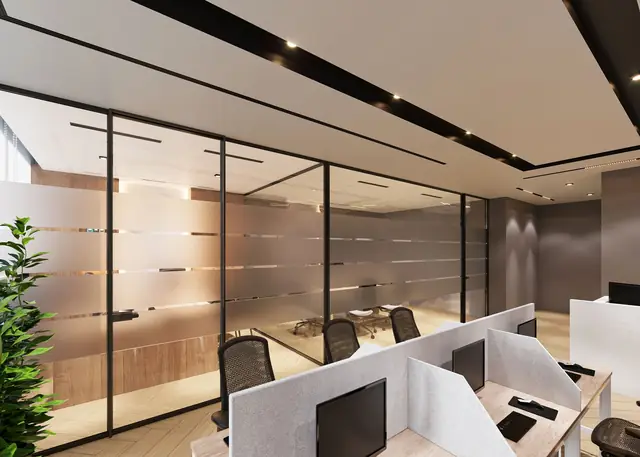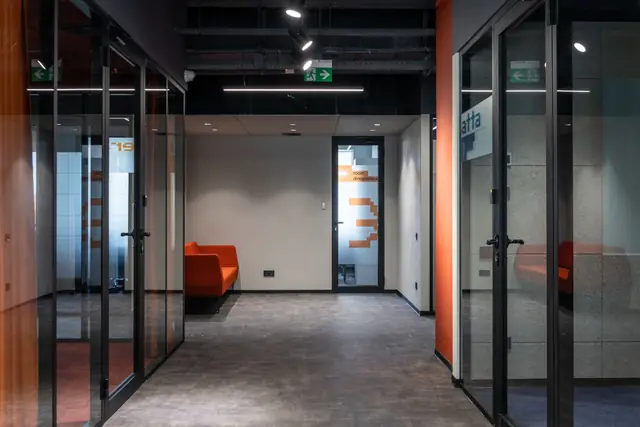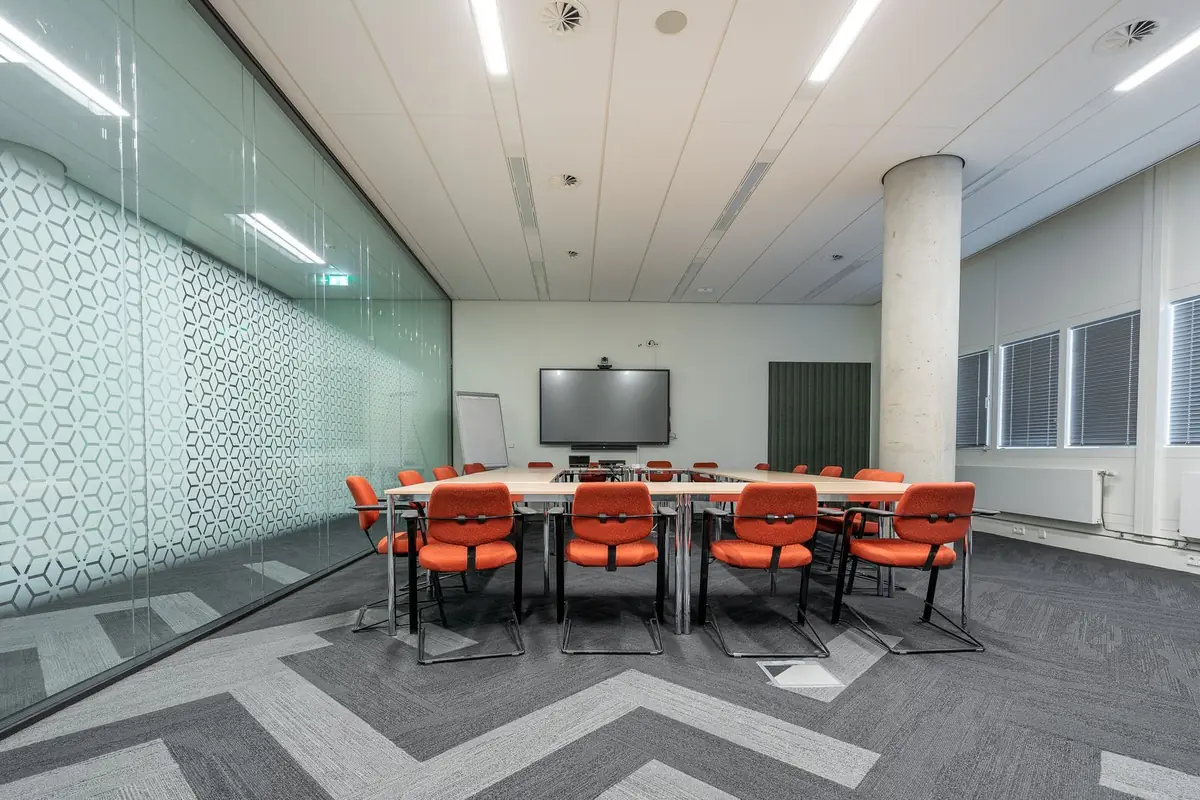
PDLC smart glass is laminated glass with a liquid crystal layer: it is milky opaque when the power is off and clear when it is on, at the press of a button. It is worth the spend when you need changeable privacy, such as a meeting room, clinic or consultation room, and usually not when fixed privacy from frosted glass at lower cost is enough.
What is PDLC smart glass?
The full name is Polymer Dispersed Liquid Crystal. This layer is placed as a thin film between two clear sheets (glass or plastic) with electrically conductive coatings, then bonded inside a laminated pane. It is not “glass that darkens in the sun” and it is not an electrochromic coating; it is a specific type that switches between two states depending on whether voltage is applied. It appears on the market under names such as privacy glass or switchable glass. How does it work, step by step? In the off state, the liquid crystal molecules are randomly distributed within the layer, scattering light in every direction so the pane looks opaque, white and hazy. When switched on, an alternating current at a voltage specified by the product passes through the conductive layers and the molecules align in one direction, so light passes between them and the pane becomes clear. The switch between the two states is very fast, with some published specifications citing times in fractions of a second. The clear state does not become “perfectly ordinary glass”: a slight haze remains in the clear state, and its value varies between products. Products differ in several things that affect your decision: the light transmittance in each state, the level of haze in the clear state, the operating voltage, the stated operating life, and whether a frame is needed to protect the edges. Do not compare two products by name; ask for two data sheets and compare the same figures, and if that is not possible, ask for a working sample so you can judge for yourself. The default state: what happens when the power fails? In most of this type, the pane is opaque when power is off and clear when on. This means that to keep the pane clear you need the current to stay connected. This is a point many orders overlook: if you want transparency most of the time (a display front, for example), you will consume electricity continuously, and if the power is cut the pane turns opaque. Some manufacturers talk about a reverse-function type (sometimes known as reverse mode) that is clear when off, so ask about it if transparency is the main state.
What are the advantages of smart glass?
- Instant privacy when needed, without curtains or blinds that need maintenance.
- A clean look, and the pane can be used as a projection screen in the opaque state (with suitable setup).
- It keeps more natural light than curtains when partially darkened.
- Its build is laminated glass, so it brings its advantages: safety after breaking and blocking part of the ultraviolet rays, depending on the product.
- Flexible control: wall switch, remote, sensor or connection to a building management system.
What are its limits and drawbacks?
- The cost is much higher than frosted glass or film; it includes the pane, transformer, controller and wiring.
- It needs electricity, a transformer and wiring, a place for the transformer and advance planning in the wall or ceiling.
- In the clear state a slight haze remains, and it does not match the clarity of ordinary glass.
- It is not a solution for thermal or acoustic insulation on its own; it is laminated glass whose function is privacy. For sound, see sound insulation with glass.
- Sensitive to moisture and water at the edges and connections; edges must be sealed and damp areas avoided unless the product is rated for them.
- Exterior use or direct sun is not suitable by default, since ultraviolet rays, heat and moisture can affect the layer and edges; it should only be specified with a product its manufacturer states in writing is suitable for outdoor use.
Smart glass vs. privacy alternatives
| Criterion | Smart PDLC | Frosted / printed | Film | Curtains / blinds |
|---|---|---|---|---|
| Privacy | Variable by button | Fixed | Fixed | Variable by hand |
| Cost | Highest | Medium | Often lowest | Depends on type |
| Electricity | Required | No | No | No / switch |
| Upkeep | Careful cleaning and checking connections | Cleaning | Careful cleaning; may need replacing | Cleaning and mechanical maintenance |
| Suitable for | Meeting rooms, offices, clinics | Partitions and bathrooms | Existing glass | Flexible windows |
Where is smart glass worth it?
- Meeting rooms: clear to show the meeting to visitors, opaque for confidentiality.
- Clinics and examination rooms: temporary privacy with natural light.
- Executive offices and open-plan offices that need privacy from time to time.
- Patient rooms and review rooms, where the ability to control without a curtain that needs cleaning is useful.
- Interior display fronts or projection screens when needed, with special specifications.
- Also see the office glass partitions guide for details on privacy, sound and cost.
And when is it not worth it?
- If the privacy is always fixed: frosted glass or opaque laminated glass is cheaper and simpler.
- In bathrooms and kitchens and damp places, unless the product is explicitly rated for it.
- If the budget is limited and privacy can be solved with film on existing glass.
- If you expect frequent power outages and need the partition to stay clear.
- If there is no installer and maintenance provider who understands the special electrical connections of the glass.
How much electricity does it use?
Smart panes use relatively little power, but it is continuous in the clear state. Published figures vary between manufacturers and specifications; some give watts per square meter, with values that differ by product and number of panes, so we do not fix a number here. Ask the supplier for a data sheet that states the voltage and the consumption per square meter, and work out with the electrician the number of transformers and their capacity for the total area. Panes should not be installed on a single transformer without calculation. The value of smart glass is in its flexibility; if you do not need flexibility, you are paying for a feature you do not use. Try to estimate how many times a day you will change the state, and if it is very few, frosted glass or curtains may be more suitable.
How is smart glass installed? (overview)
- Accurate dimensions: the pane is made to size and is not modified after assembly, as with laminated glass.
- Electrical planning: the location of the transformer and controller and the wire route before installation, with suitable ventilation for the transformer.
- Deciding the connection side: the wire exits from the pane's edge, and the edge must be hidden in a frame or a sealed channel.
- Fixing the pane within an aluminum frame or a base that protects the edges from water and moisture.
- Connection and testing: a qualified electrician connects the transformer, then switching between the two states is tested before handover.
- Handover: the user is shown how to operate it and what must not be done when cleaning.
Care and maintenance
- Clean with a mild, ammonia-free cleaner and a soft cloth, and avoid abrasives and solvents.
- Do not soak the edges with water and do not spray liquid directly on the connections.
- Have the connections and transformer inspected periodically by a qualified electrician.
- If spots, color changes or uneven switching appear, notify the supplier and do not try to dismantle it yourself.
- Do not stick items on smart glass and do not expose it to direct heat it was not designed for.
Questions to ask the supplier
- Is the product rated for indoor or outdoor use, and what are its humidity and temperature limits?
- What is the operating voltage and consumption per square meter, and what are the transformer and controller specifications?
- What is the haze level in the clear state and the light transmittance in both states?
- How are the edges and connections protected, and what frame is recommended?
- What does the written warranty cover for this product and for how long? (Ask for it in writing; we state no period here.)
- What is the solution for darkening if power is cut, if transparency is what is required?
How does the user control smart glass?
There are many ways to control it: a simple wall switch, a remote, a phone app, a connection to a smart system, a presence sensor, a timed schedule, or a building management system. What you need in practice depends on the number of panes: one pane needs only a switch, and a room with several panes needs a central controller. If you want to control more than one pane together, ask the supplier to specify the transformer locations and the grouping, because each pane sometimes has its own circuit or group. Ask for the quotation to state the type of control, not only the pane. What should be planned in the building before ordering? Smart glass needs coordination between glass, electrical and joinery or aluminum work. Plan ahead for the transformer location so it is accessible for maintenance, for the wire route inside the frame or the suspended ceiling, and for a nearby power supply point. Avoid putting the transformer in a hot or damp place. Make sure the aluminum frame or channel protects the pane's edges and hides the connections neatly. Many problems that occur after installation come from decisions made late in planning, not from the pane itself.
Common mistakes when ordering smart glass
- Ordering from pictures only without seeing a working sample and judging the haze level.
- Not including the transformer and controller in the budget, so the cost looks lower than it is.
- Placing it in a damp or water-exposed environment without an explicit specification.
- Forgetting that the default state is opaque when power is cut.
- Installing it without a qualified electrician or without testing before handover.
- Assuming it replaces sound or thermal insulation.
Smart glass and long-term maintenance
Smart panes do not need radically different cleaning, but they need attention to the edges and connections. Periodically check that the frame is intact and that no water is seeping at the base, and make sure they are cleaned with care. Because the technology includes electrical components, keep the supplier and transformer information and ask for the operating manual in writing. If uneven spots or a color change appear in the layer, notify the supplier instead of waiting; some faults start small at the edge and then spread. Can smart glass be installed on existing glass? Yes, with a PDLC film applied to existing glass, an option on the market known as smart film. But it differs from factory-made laminated glass in that the edges are more exposed to moisture and scratches, adhesion quality depends on the workmanship, and electrical connections are needed. So for damp or direct-sun locations, factory-made laminated glass is preferable, subject to review by the manufacturer. Ask the supplier about the difference in durability and warranty between the two before choosing, and do not rely on price alone. What is the difference between PDLC and other dimming types? There are other technologies for controlling light through glass, such as electrochromic glass, which changes color gradually and slowly and is used to reduce glare, or thermochromic glass, which changes with heat. PDLC, however, aims at quick privacy, not control of solar heat. If your goal is to reduce solar heat, rely on coatings, shading and insulated glass as in the article on insulated glass and Low-E, not on PDLC.
Decision checklist: do I need PDLC?
- Does the need for privacy change during the day? If yes, it is a candidate.
- Is there electricity nearby and a safe place for the transformer?
- Can the budget bear the difference from frosted glass, including the transformer and controller?
- Is the location dry and indoors, and can the edges be protected?
- Do you have a reliable installer and maintenance provider who gives a written warranty?
- If most answers are “yes,” request a detailed quotation and a working sample.
Summary
PDLC smart glass is a good solution for changeable privacy, but it is not a substitute for every type of privacy glass. Use it when the need switches between clear and opaque several times a day, plan the electricity and edges early, and ask for a written data sheet. If the privacy is fixed, compare it with the alternatives in the privacy glass article, and you can request a measurement and detailed quotation for office partitions from the glass office partitions service.
FAQ
How does PDLC smart glass work?
The laminated pane contains a liquid crystal layer. When the power is off, the molecules are randomly arranged and scatter light, so the glass looks opaque; when the power is on, the molecules align so light passes through and the glass becomes clear.
Does smart glass stay clear when the power is cut?
In the common PDLC type, the pane is opaque when power is off and clear when on. Consumption therefore continues in the clear state, and there are reverse-function types that you should ask the supplier about.
Does smart glass insulate against sound or heat?
Not on its own; it is laminated glass whose function is privacy. For thermal or acoustic insulation, a different build-up such as an insulated unit or acoustic laminated glass is needed, and performance is set from the supplier's data sheet.
Is smart glass suitable for bathrooms?
It is not recommended in damp places unless the product is explicitly rated for it, because moisture at the edges and connections is a major cause of failure. Frosted or printed glass suits bathrooms better.
Can smart glass be cut after it is made?
No. It is made to the required size as laminated glass and cannot be cut or modified after assembly. It therefore needs an accurate on-site measurement and electrical planning before ordering.
What are the lower-cost alternatives to smart glass?
Frosted, printed or privacy film for fixed privacy, and curtains or blinds for manually variable privacy. Each alternative differs in permanence and upkeep, and they are compared according to use.