To block the view through glass while keeping the light, there are five main options: sandblasted or acid-etched frosted glass, ceramic printing, film applied to existing glass, laminated glass with an opaque interlayer, and PDLC smart glass that switches with electricity. No option is best in every case; the right one depends on permanence, budget, upkeep and whether the glass is new or already installed.
What is privacy glass?
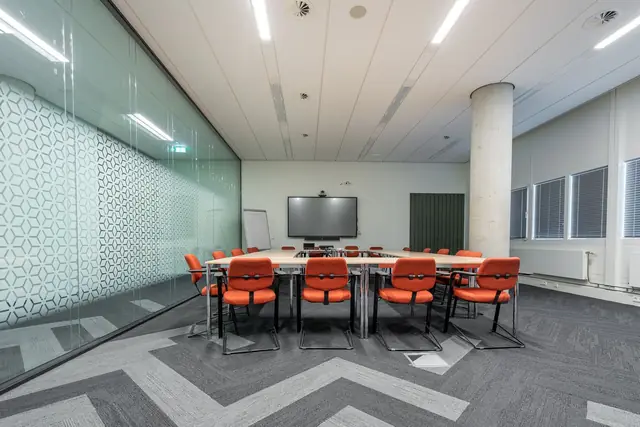
Privacy glass is any glass whose surface or build-up is altered to scatter vision through it so no one sees the details, while some natural light remains. It is used in bathrooms, bedrooms, office partitions, meeting rooms and clinic doors. What matters when choosing is not the name but the level of concealment (are shadows visible or not), permanence, ease of cleaning and removability. The first question we ask a customer is: from where will the glass be viewed? And when? And what exactly do you want to hide (people, desks, room contents)? The answers determine whether a light frosting is enough or you need full concealment, and whether you need privacy in the daytime only or at night too. Much of the disappointment after installation comes from privacy being tried in daylight and never tested at night. What is sandblasted glass? Abrasive grains are sprayed at high pressure onto the glass surface, creating a rough surface that scatters light. This method allows gradients, designs and logos with defined opaque and clear areas, and it is the most flexible in design. The surface is permanent because it is part of the glass. Its limits are that the rough surface may retain oils and fingerprints, so it needs suitable cleaning, and that the result depends on the skill of the execution and the evenness of the abrasion. Frosting and design can be combined: a company logo as a clear area inside a frosted pane, or decorative patterns in interior doors and majlis rooms. Because every design is made with a stencil, ask for an approved layout before execution and keep it, since changes after sandblasting are not possible. What is acid-etched glass? The surface is treated with a chemical that etches it finely and evenly, giving a smooth, more uniform matte look. Its texture tends to be smooth and appears uniform across large areas, but its design and gradient possibilities are fewer than sandblasting. It is also permanent, and commercial sources state that fingerprints are often less visible on it than on sandblasted glass, but do not rely on that before asking the supplier about fingerprint resistance for the exact product you will buy, as this varies with the method and finish. What is ceramic-printed (frit) glass? Ceramic ink is printed on the glass in dots, patterns or full color and then fused to the surface during tempering. The result is privacy at a blocking ratio controlled by the print density, with options for logos, geometric shapes and colors. This requires tempering, so dimensions and printing are specified before manufacturing and cannot be changed later. It suits facades and partitions that need a fixed visual pattern, and in some cases reduces glare. What is privacy film? An adhesive film applied to existing glass, a common solution for installed glass without replacing it. It comes in different grades of frosting or in patterns. Its advantages are fast installation, low cost and removability; its drawbacks are that over time it can be affected by heat and incorrect cleaning (edge peeling, bubbles or yellowing), and its quality does not last as long as the glass itself. In Riyadh, where the sun is direct, choose a type designed for use on sun-exposed glass, and on insulated glass the film should be applied only with written approval from both the film manufacturer and the unit manufacturer, because the unit may suffer thermal stress or its warranty may be affected. What is opaque laminated glass? Laminated glass with an interlayer (PVB or EVA) that is frosted, colored or opaque in varying degrees. It combines privacy with the safety of laminated glass and UV blocking, because the interlayer provides the concealment so the surface is not affected by fingerprints. It suits partitions, doors and canopy roofs that need light without visibility. It is usually costlier than simple frosted glass and does not allow detailed designs. For details, see the laminated glass guide. What is PDLC smart glass? It is laminated glass containing a liquid crystal layer that switches from opaque to clear when an electric current passes through it. Its privacy is on demand: you turn it on and off with a button, remote or controller. It costs more and needs electricity, a transformer, wiring and special maintenance. We have given it a full article, the PDLC smart glass guide.
Comparison of privacy options
| Option | Permanence | Design flexibility | Upkeep | Best for |
|---|---|---|---|---|
| Sandblasted | Permanent | High (designs and gradients) | May retain fingerprints | Partitions, doors, decor |
| Acid-etched | Permanent | Medium (uniform surface) | Often easier, depending on the product | Large uniform areas |
| Ceramic frit | Permanent after tempering | High (patterns and colors) | Easy | Facades and partitions with a fixed pattern |
| Privacy film | Limited and removable | Good | Careful cleaning | Existing glass and limited budgets |
| Opaque laminated | Permanent | Limited | Easy | Where safety and privacy are both needed |
| Smart PDLC | Permanent but needs electricity | Instant control | Higher | Meeting rooms and private rooms |
Which option for which place?
- Bathroom and shower: frosted, etched or printed, specifying that the treated face is on the side least exposed to water and soap. See the shower enclosure guide.
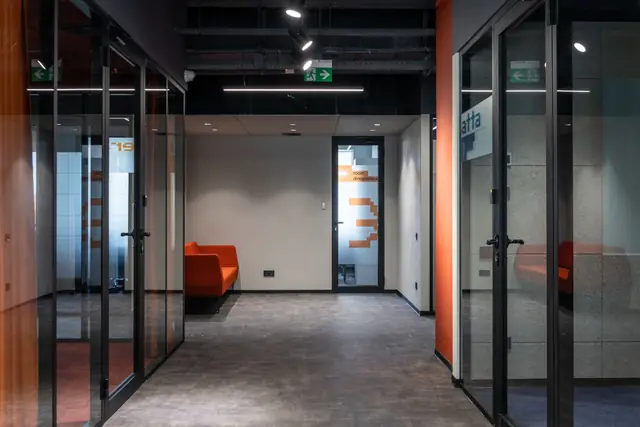
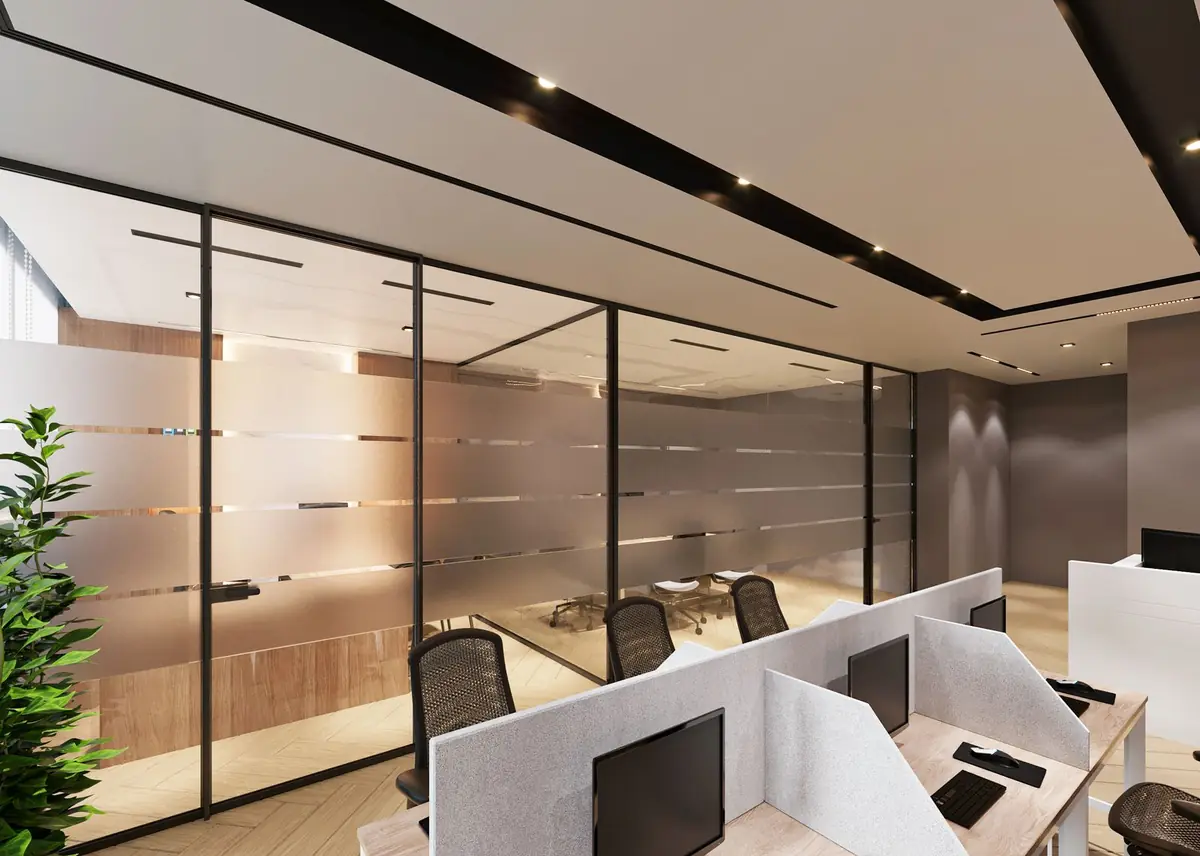
- Office partitions: partial frosting (a privacy strip at eye level) or opaque laminated glass; for sound insulation see the office partitions guide.
- Meeting rooms and clinics: PDLC smart glass if the privacy is temporary, otherwise frosted.
- Home entrance doors: printed or frosted in a fixed pattern, and for exposed entrances frosted tempered glass is preferred.
- Existing glass you don't want to replace: privacy film suited to use on sun-exposed glass.
Full or partial privacy?
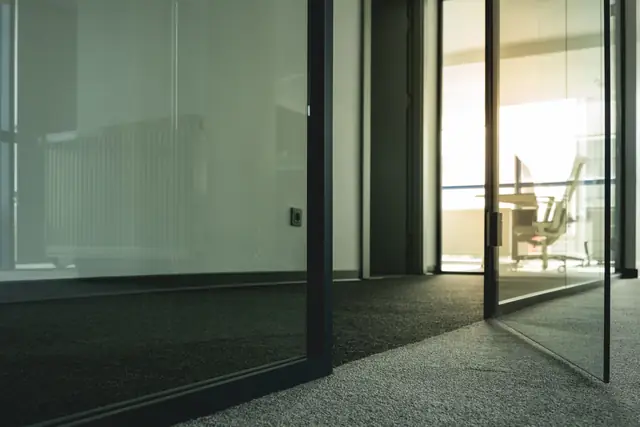
Before choosing the type, decide the level of concealment. Full concealment means people behind the glass appear only as blurred shadows, which suits bathrooms. A partial strip (such as a frosted strip at body height) hides the important part while leaving transparency above and below, and it is common in offices because it achieves privacy without losing the sense of openness. Note that any daytime privacy may reverse at night: when the room is lit from inside and it is dark outside, people outside can see into the room clearly through glass that does not block details. So ask about night-time performance.
How do you clean privacy glass safely?
- Use a gentle cleaner and a soft cloth, and avoid abrasive materials and rough brushes.
- On film: do not use cleaners containing ammonia or strong solvents unless approved by the manufacturer, and do not press on the edges.
- On frosted glass, if fingerprints are stubborn, try warm water and a mild cleaner followed by a dry wipe, and avoid scratching.
- On smart glass: switch off the power before heavy cleaning and avoid spilling water at the edges and connections.
- For limescale and hard stains, see removing limescale from glass and follow the tips before trying any solution.
Checklist before ordering
- Decide the required level of concealment and whether you want a strip or a full pane.
- Specify the treated face (inside or outside) in the quotation, since it affects cleaning and appearance.
- Request a sample and see a real piece in the lighting of the site before execution.
- Ask about tempering: will the glass be tempered after treatment or before?
- If the glass is in the sun, ask about the product's heat tolerance, especially for film.
- Add to the quotation the expected maintenance and the permitted cleaning.
Frosting before or after tempering?
Glass that will be tempered must have its treatment specified with the factory before manufacturing, because some treatments are done before tempering and some after, depending on the method and the supplier's facilities. The reason is that the surface of tempered glass is under internal compressive stress, and heavy abrasion or deep etching on a tempered surface may weaken or break it. So do not assume that “any tempered pane can be frosted later,” ask the supplier explicitly about the approved sequence, and make sure your quotation states that the pane is both tempered and treated, not just one of them. How do lighting and angle affect privacy? Privacy is not a property of the glass alone but the result of the glass interacting with light: the stronger the light behind a person, the more their shadow shows, and the closer they stand to the glass, the clearer their features appear to the viewer. So the pane is tested in the actual lighting of the site at night and by day before it is approved. In bathrooms it is preferable for the stronger lighting to be on the side of the person who wants privacy, so the light does not act as a backlight revealing the shadow, and in offices a frosted strip at a suitable height is preferable to relying on a light degree of frosting.
Common mistakes with privacy glass
- Choosing the grade from a picture on a screen without seeing a real sample in the intended lighting.
- Forgetting to specify the treated face, so the frosting is installed on the side that gets dirty quickly.
- Applying film to an insulated unit without asking the manufacturer about suitability, which may cause thermal stress.
- Using harsh cleaners that damage the film or leave marks on frosted glass.
- Believing frosting also blocks sound; it only blocks the view.
- Ignoring safety: frosted glass that someone might hit must be tempered or laminated.
What is the difference in safety between these options?
Surface treatment (frosting, etching or printing) changes the appearance and not the safety of the glass; if the base is float glass, it breaks into sharp shards however frosted it is. So for doors, partitions and showers, ask for the base to be tempered, and for locations that call for cohesion after breaking, ask for laminated glass. As for film, some types are marketed as safety film that holds shards together, but it does not turn float glass into certified safety glass, so do not rely on it in place of tempering in locations exposed to impact. For a comparison of the types, see the glass types guide.
How much does each option cost? How to compare without fixed numbers
We do not quote numbers because prices change with thickness, area, design and complexity. But the general order is: film is often the cheapest because it is applied to existing glass, then simple frosting, then printed depending on the design, then opaque laminated, and smart glass is the highest. When comparing, calculate the cost over the service life, not on day one: a film that is replaced after some time may cost more than a permanent treatment. And ask for the film warranty and its terms in writing.
Privacy in offices: the right strip height
In office partitions, designers use a frosted strip at eye level when seated and standing, so it hides people without closing off the sense of openness. There is no single correct height; it is set by the seated eye height, the position of the desks and the privacy need, and is tested on a sample pane or with a paper strip before execution. For sound and cost aspects, see office glass partitions.
Does privacy glass affect natural light?
Yes, to varying degrees: frosted and etched glass pass diffused light but reduce clarity of vision, translucent film reduces light transmission more, and dot-printed glass passes light between the dots. The goal is to keep the feel of a bright room without exposure. Ask the supplier for the light transmittance of the product you choose if light is an important factor, and test the sample in front of a real window.
Summary
Choose privacy according to what you actually want: a permanent design (frosted or printed), safety with privacy (opaque laminated), a quick fix on existing glass (film), or instant privacy (smart). Ask for a sample, specify the treated face and level of concealment in writing, and think about night. For new work, you can request a measurement and detailed quotation from our glass office partitions service.
FAQ
What is the difference between frosted and acid-etched glass?
Frosted glass is treated mechanically with sand, giving more flexibility in designs and gradients, while etched glass is treated chemically, giving a smoother, more even matte surface. Both are permanent, and they differ in texture and ease of cleaning.
Does frosted glass block the view completely?
It blocks details and shows vague shadows depending on the degree of frosting and the distance from the glass. For full concealment, request a sample and try it close to a person, and note how visibility changes at night when the interior is lit.
Is privacy film a good alternative to frosted glass?
It is a good, quick solution for existing glass and smaller budgets, and it can be removed, but it does not last as long as frosted glass and may be affected by heat and cleaning. For permanent new work, treating the glass itself is preferable.
Can tempered glass be frosted after it is tempered?
It is better to specify the treatment before tempering. Tempering is done on the final glass, and the sequence of treatment and tempering is agreed with the supplier according to the type of frosting or printing.
What is the best option for office partitions?
Usually a frosted strip at eye level for partial privacy, opaque laminated glass where safety is needed, or smart glass for meeting rooms that need temporary privacy.
Is privacy glass suitable for bathrooms?
Yes, frosted, etched or printed glass is used in bathrooms, with the treated face specified carefully and the rough surface oriented away from direct water and soap to make cleaning easier.