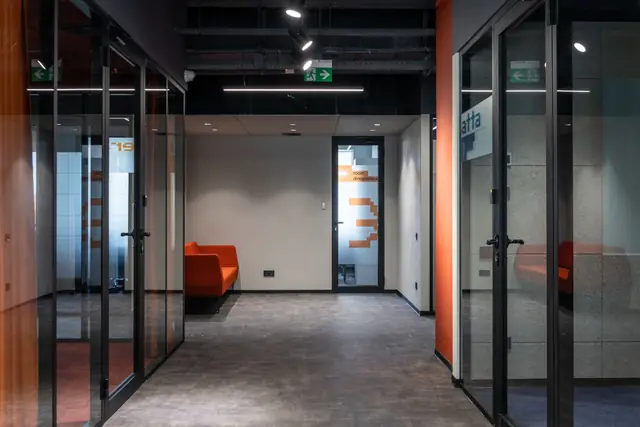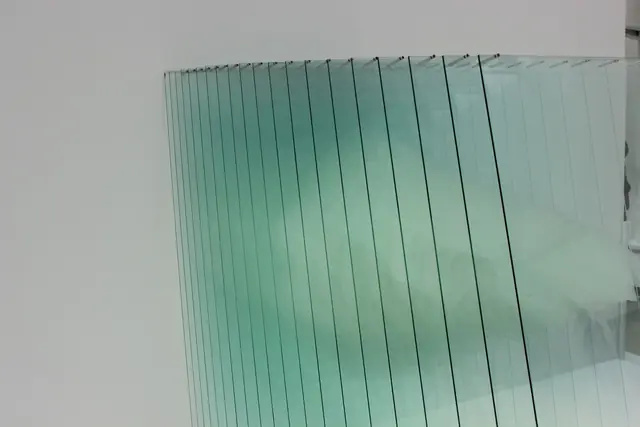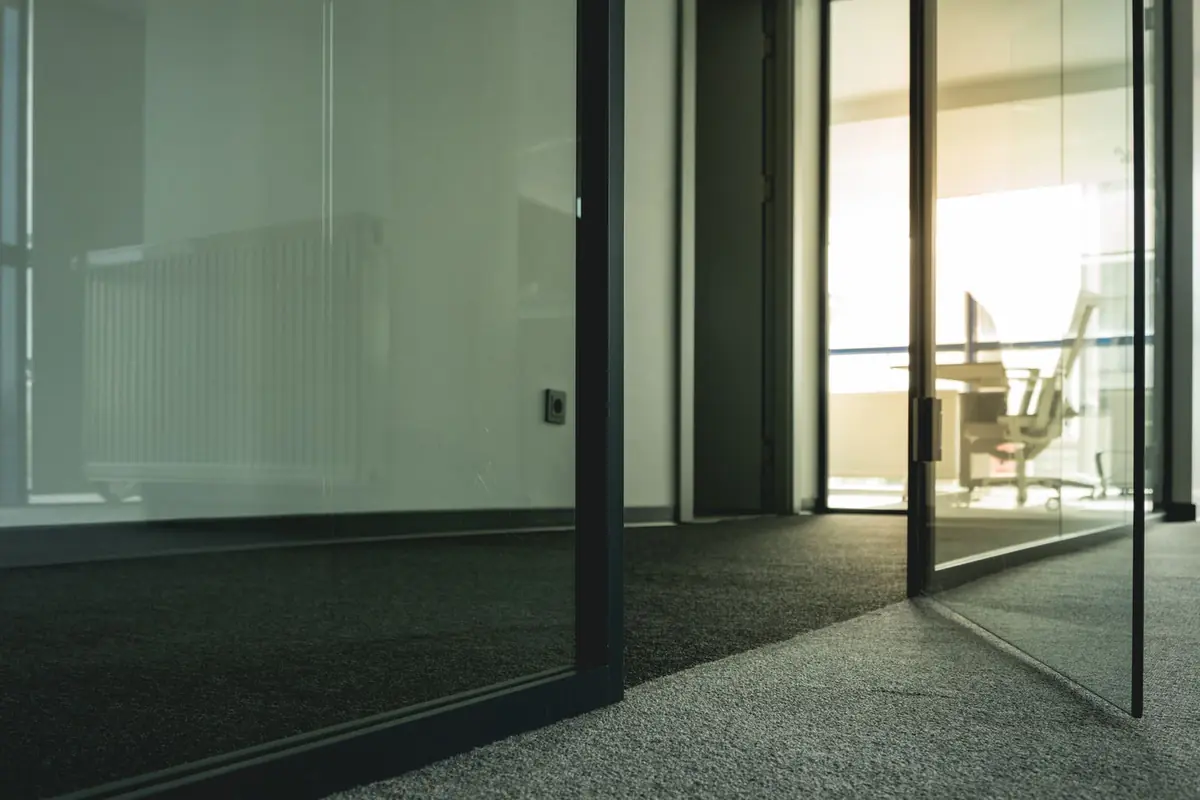
Tempered glass (also called toughened glass) is ordinary glass that has been heated and then cooled rapidly with air, leaving its surface under compression and making it several times stronger than regular glass of the same thickness. If it breaks, it crumbles into small granules instead of sharp shards, but it cannot be cut or drilled after manufacture, so every detail is fixed before tempering.
What is tempered glass and why is it called that?
In the Arabic-speaking market, tempered glass is commonly sold under the name "securit", and in English it is called tempered or toughened glass. It should not be confused with heat-strengthened glass, which is a different product cooled more slowly, so its strength and breakage pattern are different. It starts as an ordinary flat sheet of float glass that is first cut to its final size, has its edges finished and its holes and notches made, and then goes into the tempering furnace, where it is heated until it approaches softening and is suddenly cooled by blowing air onto both surfaces. After this process its shape and colour stay almost the same, but its internal structure changes completely. It is used in doors, partitions, shower enclosures, balustrades, facades, tabletops and shelves, in other words wherever glass may be hit or people come close to it. You will find a comparison with the other glass types in the glass types guide.
How does the tempering process work, step by step?
The process starts with inspecting and cleaning the sheet, which then passes through a horizontal furnace that raises its temperature gradually and evenly. When it comes out, strong, uniform air jets hit both faces, so the surface cools quickly and hardens first while the core stays hot and hardens later. As the core then contracts, it pulls the surface inward, creating permanent compressive stress at the surface balanced by tensile stress in the core. This stored balance is the secret of its strength, and also the reason for the way tempered glass breaks. Because tension and compression must be spread evenly across the whole sheet, the quality of the furnace, the cooling control and the cleanliness of the glass directly affect the result, which is where the slight waviness we discuss later comes from.
Why is tempered glass stronger than ordinary glass?
Glass usually breaks when its surface is put under tension, and the break starts from a microscopic flaw or a small scratch. In tempered glass there is permanent compression at the surface, so an outside load must first overcome this compression before real tension reaches the breaking point. The result is that the sheet withstands impacts and loads several times higher than an ordinary sheet of the same thickness, and it also tolerates larger temperature differences. But this strength depends on the surface being sound, and the weakest point of the sheet is the edge and its corners: a localised blow to the edge is more dangerous for it than a load spread over the face. That is why we always recommend polished edges and protecting the corners during transport and installation. When it breaks, the energy stored in the whole sheet is released at once, and it crumbles into relatively small pieces with less sharp edges than the long, pointed shards that ordinary glass leaves. This is why it is the standard choice for doors, showers and places near people. The European standard EN 12150 covers thermally toughened soda-lime silicate safety glass and includes a fragmentation test that verifies the breakage pattern, while the American standard ASTM C1048 covers heat-treated flat glass (tempered and heat-strengthened). One important point to note: tempered glass is "safer" than ordinary glass when it breaks, but it does not stay together after breaking, so if there is a risk of a fall from height behind it, or a risk to people from falling pieces, the solution is laminated glass, as explained in the laminated glass guide.
What can you not do with tempered glass after tempering?
- It cannot be cut to reduce its size; any attempt to cut it breaks the whole sheet.
- It cannot be drilled to add a hole for a handle, hinge or lock.
- Its edges cannot be altered and no new notches can be added for hinges and patch fittings.
- A deep scratch cannot be repaired by sanding or polishing, because that weakens the surface.
- So everything is settled before tempering: the final size, the edge type, the positions of holes and notches, and the type of hardware that will be installed. This is why accurate measuring is the most important step in the project, and the measuring guide explains how to avoid mistakes in it.
Which tempered glass thickness suits each use?
| Thickness | Common use (varies with the design) | Note |
|---|---|---|
| 6 mm | Shelves, small tables and framed panels | Most light-duty use inside a frame |
| 8 mm | Framed showers and light doors | Suits framed systems and medium sizes, depending on the hardware |
| 10 mm | Doors, partitions and frameless showers | A common thickness for frameless doors |
| 12 mm | Large doors and tall partitions | Heavier, and needs hardware rated for this weight |
| 15-19 mm | Facades and large entrances | Determined by engineering calculation, not by estimate |
Tempered, laminated or ordinary glass: how do you tell them apart?
Ordinary glass is cheap but breaks into sharp shards and is not suitable near people in doors and showers. Tempered glass is a single tempered sheet that withstands more and crumbles when it breaks. Laminated glass is two or more sheets bonded with an interlayer (often PVB) that keeps the pieces stuck together after breakage; the EN ISO 12543 series covers laminated glass in the European standards, and ASTM C1172 covers architectural laminated glass in the American standards. There is also a third option, laminated tempered glass, meaning heat-treated layers that are then bonded; it is a common choice for balustrades, roofs and high places, and its exact type is settled by engineering calculation. The practical rule: if the risk is impact, tempered glass is the usual choice, and if the risk is a fall or falling pieces, ask about laminated glass. For more on balustrades, read the article glass balustrade: laminated or tempered.
Can tempered glass break suddenly for no reason?
Very rarely, but it is possible. One known cause is microscopic nickel sulfide inclusions inside the glass, which can slowly expand over time and cause sudden breakage. Breakage can also come from an unnoticed edge flaw, from improper installation pressure such as glass rubbing against metal, or from a localised temperature difference such as a sharp shadow on a sheet heated by the sun. The nickel sulfide risk is reduced by a heat soak test at the factory, an additional process covered by the European standard EN 14179 (heat-soaked thermally toughened safety glass) and not automatically included in EN 12150; it is usually requested according to the project specification for tall facades and critical locations. But it lowers the likelihood rather than eliminating it, and it adds cost, so it is not requested for every shower door. Details are in the article on spontaneous breakage and nickel sulfide. You may notice slight optical waviness in the reflection of tempered glass, or spots and streaks that appear at certain angles or through polarised glasses. They are caused by the heating and cooling process and by the glass touching the rollers inside the furnace, and they are an expected effect within limits the standard accepts, not a sign of structural weakness. They show up more on large reflective facades in sunlight than on an interior door. If appearance matters in your project (a facade, a large office partition), ask the supplier about the accepted limit and ask to see a sample or an installed sheet at a previous site before approving the order.
Common myths about tempered glass, and the facts
- Myth: Tempered glass does not break. Fact: It does break, especially from a blow to the edge or from a hidden flaw.
- Myth: It can be trimmed slightly on site. Fact: Any cutting or grinding breaks or weakens it, and it has to be remade.
- Myth: All thick glass is tempered. Fact: Thickness is one thing and tempering is another; ask about the marking and the documentation.
- Myth: Tempered glass protects against heat and radiation. Fact: It is mechanical strength; insulation and solar control need insulated or Low-E glass, as in the article on insulated Low-E glass.
- Myth: Laminated and tempered are two names for the same thing. Fact: They are different principles and can be combined.
What matters most for you in Riyadh?
The intense sun heats exterior glass unevenly when part of it is shaded, and this raises the thermal stress at the edges, so for facades and canopies it is best to involve a specialist who decides whether tempering, heat strengthening or laminated glass is needed. Dust and sand scratch the surface when cleaned dry, so use a damp cloth instead of dry wiping. Hard water in bathrooms can leave limescale on doors and showers, so wipe after use. In apartments and villas, tempered glass is widely used for showers, interior doors and office partitions, all of which are made from on-site measurements before manufacture.
Questions to ask the supplier before ordering
- Is the glass really tempered, and where is the manufacturer's stamp or mark on the sheet?
- What thickness is suggested and why, and what edge type (polished or raw)?
- Is the measurement taken on site, and is the final size approved in writing before manufacture?
- Does the quote separate the glass from the hardware and installation? And which hardware is named?
- Does the location need laminated glass or a heat soak test?
- Who bears the cost of a sheet damaged during installation, and is this written in the quote?
- How is the glass transported and wrapped to protect the edges?
Where is tempered glass used at home and in the office, and what should you watch for?
| Use | What to watch for | Decision point |
|---|---|---|
| Bathroom shower | Floor slope, gaskets and limescale | Door weight stays below the hinges' rated limit |
| Frameless interior doors | Hardware and floor spring (door weight below its rated limit) and door rebound | Hinged or sliding, depending on the space |
| Office partitions | Privacy, sound and ease of moving later | Clear, frosted or smart glass |
| Shopfronts | Wind load, fixing and safety for passers-by | Needs a designer and calculation |
| Shelves and tables | Polished edges and protected corners | Thickness according to the load placed on it |
| Balustrades | What happens after breakage | Laminated glass and structural calculation |
What is the journey of your order, from measuring to installation?
- Enquiry and photos: you send photos of the place and the intended use of the glass, and we decide what we need for the site visit.
- On-site measuring: we measure accurately and document the edges, holes and hardware type.
- Written quote: it itemises glass, hardware and installation line by line.
- Written approval of the sizes: this is the last point where changes are possible before tempering.
- Manufacturing: cutting, finishing and drilling, then tempering.
- Installation: with the right fixing, silicone and a final check.
- You will find more detail in the stages of a glass project.
How do you care for tempered glass after installation?
Tempered glass needs no complicated maintenance, but a few simple habits extend its life. Wipe it with a soft damp cloth instead of dry wiping, which carries Riyadh sand grains that scratch the surface. Avoid abrasive tools and sharp metal, and do not knock its edge with chairs or cleaning equipment. Watch the hardware: if you notice a door rubbing on the floor or a loose hinge, ask for it to be adjusted quickly before the friction turns into pressure on the edge. And do not hang weights on frameless glass doors.
Summary
- Tempered glass is ordinary glass toughened by heating and rapid cooling, several times stronger, and it crumbles into small pieces when it breaks.
- It cannot be cut or drilled after tempering, so accurate measuring and complete specifications are settled before manufacture.
- Its edge is its weakest point, so ask for good polishing and an installation with no contact with metal.
- For high places, balustrades and roofs consider laminated glass, and ask about a heat soak test where the project specification requires it.
- Ask for a written quote that separates glass, hardware and installation, and an on-site measurement before execution. To reach our team in Riyadh, visit the tempered glass service page.
FAQ
Is tempered glass more expensive than ordinary glass?
Usually yes, because it goes through an extra manufacturing stage in the tempering furnace, and its edges and holes are prepared beforehand. The difference varies with thickness, size, quantity and finish, so we give you a written quote once we know the details rather than a general figure that could mislead you. To understand what makes up the price, see the article on how tempered glass is priced. This does not mean paying more for no benefit: tempering is required anyway in doors and showers for safety, and the difference is justified.
Can tempered glass be installed outdoors?
Yes, it is used in facades, canopies and outdoor balustrades, provided the design accounts for wind loads and temperature differences, and the fixings, gaskets and silicone suit outdoor conditions. In high places, or where pieces could fall, we recommend laminated tempered glass, and that is decided after inspection. Gaskets and fixings should be checked regularly, and sharp partial shading on the sheet in the sun should be avoided.
Does tempered glass block ultraviolet rays and heat?
Not noticeably in itself, because tempering concerns mechanical strength, not insulation. Laminated glass, with its interlayer, reduces some of the ultraviolet radiation, and controlling heat and sun requires double glazing, a Low-E coating or reflective glass depending on your need. If the sun is a problem in your space, ask about insulated glass or Low-E coated glass suited to Riyadh's heat.
What should I do if my tempered glass sheet breaks?
Keep children and pets away from the area, and put on shoes and thick gloves before approaching, and do not touch the pieces with bare hands. Collect the granules carefully and avoid dry sweeping with a hard brush on a marble floor. Then ask a specialist to inspect it to find the cause before a replacement is installed, because the cause may be a faulty installation that would repeat.
How do I make sure the glass is really tempered?
There is usually a small printed mark or stamp in one corner from the manufacturer stating the tempering and the standard. If you find no mark, ask the supplier for documentation. Tempering can sometimes be detected with polarised glasses that reveal the stress pattern, but the mark and the documents are the most reliable way. In regulated projects you may also find a document or certificate from the manufacturer proving the glass type.
Can coloured glass, mirrors and frosted glass be tempered?
Yes, many types such as clear, tinted, frosted and coloured glass can usually be tempered, depending on the factory's capabilities. Mirrors have special considerations, so ask the supplier whether tempering suits your case. The important thing is to decide the glass type and finish before tempering, because everything is done before it. This applies to printing and frosting as well.