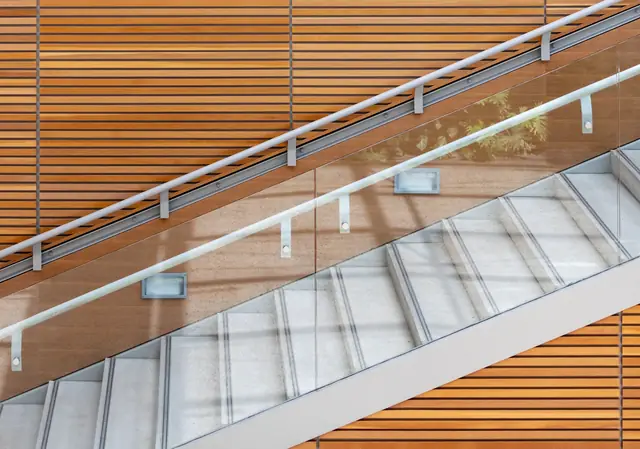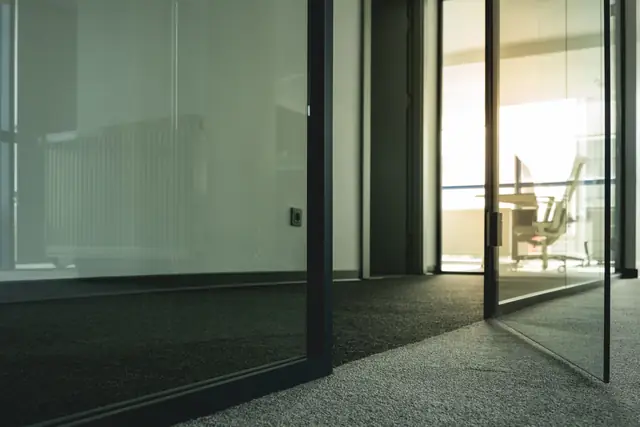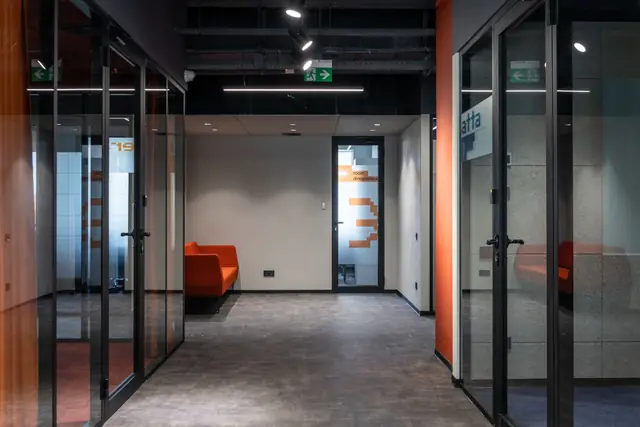
Laminated glass is two or more sheets of glass bonded by a clear interlayer, usually PVB, which holds the fragments in place and keeps the pane intact after breaking. You need it where falling glass, or a person falling against it, is a real danger, such as balustrades, roofs, canopies and high facades, and also when you want to block UV rays or improve sound insulation.
What is laminated glass?
Laminated glass is not necessarily stronger than other glass; it is glass that behaves more safely when it breaks. It consists of two or more sheets pressed and heated together with a clear polymer layer between them until the layers bond completely. The core idea is that breaking does not mean the pane falls apart: it cracks like a spider web and stays in place. The EN ISO 12543 series defines laminated glass and laminated safety glass and their requirements, and the American standard ASTM C1172 covers laminated flat glass. Laminated glass comes in types for different purposes: laminated for safety only, acoustic laminated with a dedicated interlayer, laminated with a colored or opaque interlayer for privacy and decor, and multi-layer laminated where higher impact or break-in resistance is required. Because each type serves a different purpose, it is best to start from the purpose (safety, sound or privacy) and then ask for the appropriate build-up, rather than ordering “laminated glass” in general terms and leaving the rest to guesswork. How does laminated glass behave when it breaks? On impact the glass ply cracks, but the fragments stay bonded to the flexible interlayer instead of scattering. The pane keeps its shape for a while, prevents sudden falling and gives you time to react and replace it. This is what sets it apart from tempered glass, which shatters into small pieces and may fall out of its frame. That is why laminated glass is used wherever the barrier must remain standing after breakage, as in glass balustrades. The post-break cohesion is temporary by nature: the flexible layer prevents fallout but does not restore the pane's original strength, so a broken pane is treated as a temporary hazard and replaced at the earliest opportunity, and no one should lean on it or rely on it as a barrier. How long the pane stays up depends on the build-up, the fixing method and the extent of the breakage. What is the interlayer (PVB and others)? The most common is PVB (polyvinyl butyral), available in several thicknesses, with one or more layers used. Alternatives include EVA and ionoplast (such as SentryGlas), which are usually used where higher stiffness or better tolerance of exposed edges is required. The interlayer's thickness and number of layers affect performance, so the specification states a build-up such as “glass + PVB + glass”, and saying “laminated” is not enough. Always verify the interlayer type, its thickness and the supplier's data sheet.
Laminated vs. tempered glass: a practical comparison
| Aspect | Tempered | Laminated |
|---|---|---|
| After breaking | Shatters into small pieces and the pane loses cohesion | Stays in one piece, with fragments bonded to the interlayer |
| Cutting and drilling | Not possible after tempering | Made to the required size; modification after assembly is impractical |
| Weight and cost | Lighter and often cheaper | Heavier and costlier, depending on the layers |
| Ultraviolet rays | Does not block them noticeably | The interlayer blocks a large share |
| Sound insulation | Ordinary | Improved, and better still with dedicated acoustic interlayers |
| Fall safety | Limited after breaking | Much better after breaking |
| Use | Doors, showers, partitions | Balustrades, roofs, canopies, facades |
Is laminated glass stronger than tempered glass?
Not necessarily. Strength before breaking depends on the type of glass used: laminated glass made from float glass cannot carry what laminated glass made from two tempered sheets can. That is why balustrades often use tempered laminated glass (two tempered sheets bonded together) to combine impact resistance with cohesion after breaking. In these cases the decision is subject to an engineering load calculation and is not left to guesswork. Does laminated glass block UV rays? Yes, the interlayer blocks a large share of ultraviolet rays, which reduces the fading of furniture, floors and artwork near the window. The exact percentage varies with the interlayer type and the build-up, so ask for the figure from the supplier's data sheet instead of relying on a general promise. This does not mean it blocks heat; blocking heat requires coatings or an insulated unit, as in our article on reducing heat through glass. Does laminated glass improve sound insulation? Yes, the flexible layer damps vibration, so insulation improves compared with a single pane of the same total thickness, and dedicated acoustic interlayers give additional improvement. Even so, sound insulation is not determined by the glass alone; the frame, airtightness and leakage paths have a strong effect. For realistic expectations, read our article on sound insulation with glass.
When do you really need laminated glass?
- Balustrades and glass bridges, where a person could fall if the pane breaks.
- Roofs, canopies and skylights, because falling fragments from above are a direct danger.
- High facades, where glass must not fall on passersby.
- Places that require break-in resistance, depending on the build-up and the specification.
- Spaces that need UV blocking, such as showrooms, shops and majlis rooms facing the sun.
- Quiet places, such as offices near roads, if sound insulation is required.
When don't you need it?
- Interior doors and ordinary shower screens, where tempered glass is enough and is lighter and cheaper.
- Shelves, small tables and interior mirrors.
- Locations that need holes or modifications after manufacturing, because laminated glass is not easily modified.
The limits of laminated glass: what you should know
First, laminated glass edges are sensitive to moisture in some exterior applications if they are not protected by suitable fixing and gaskets, and changes in the interlayer may appear over time. Second, the panes are heavier and require more careful lifting and fixing. Third, if one ply breaks, the whole unit is replaced; a single layer cannot be replaced. Fourth, production time is longer than for float glass. Ask the supplier about the suitable edge finish and the fixing details in places exposed to water, dust and high heat.
What should you ask the supplier before ordering laminated glass?
- What is the exact build-up: the glass type (tempered or heat-strengthened) and thickness of each ply, and the interlayer type and thickness?
- Has the build-up been engineered for this use (balustrade, roof, facade)?
- How are the edges protected at the fixing, and is a special edge finish recommended?
- Is there a data sheet for acoustic or UV performance, if required?
- How is the pane replaced when it breaks, and what is the expected lead time?
- Does installation include lifting and fixing, or is it supply only?
Care and maintenance
- Clean with a gentle glass cleaner and a soft cloth, and avoid strong solvents near the edges.
- Inspect the edges periodically for discoloration or separation of the layer.
- In exterior locations, keep gaskets and rubber in good condition to prevent water collecting at the edge.
- Replace a cracked pane even if it is still in one piece; its cohesion is a chance to act, not a permanent solution.
What does a laminated build-up such as 6+6 or 8+8 mean?
When specifications are written as “6+6” or “8+8”, they usually mean the thickness in millimeters of each glass ply, with an interlayer between them whose thickness is stated separately. So saying “12 mm laminated” is not enough. Ask for the quotation to state the glass type of each ply (tempered, heat-strengthened or float), the thickness of each ply, the interlayer type and thickness, and the edge finish. This makes it possible to compare two quotations and avoids being priced laminated glass made of float glass when you believed it was tempered. To go deeper into how the build-up affects price, see glass price factors. Laminated glass in balustrades and roofs: why is an engineering calculation necessary? Glass that people lean on or that sits above heads is subject to push loads, impact and sometimes wind. The fixing type (metal base shoe, point fixing, bottom profile) changes how stress is distributed across the pane. That is why the build-up is calculated by an engineer who knows the loads and the fixing method, and copying a build-up from another project is not enough. If there is a top handrail, it changes the calculation. For roofs and canopies, the calculation includes the weight of accumulated dust, wind loads and maintenance and cleaning work. We discuss this in glass canopies and roofs.
What happens when a laminated pane breaks?
- One or both plies crack, but the fragments stay bonded to the interlayer.
- The pane may stay in place for a while depending on the build-up and fixing, but it no longer carries loads as before, so use must be stopped immediately.
- Put up warning tape and keep people from approaching or leaning on the cracked pane.
- The whole pane is replaced, because the layers are bonded and it cannot be repaired by adding a layer.
- For first steps, see what to do when glass breaks.
Myths and facts
- Myth: laminated glass never breaks. Fact: it breaks, but it stays in one piece to a degree that depends on the build-up.
- Myth: all laminated glass insulates sound well. Fact: the improvement varies with the interlayer, the build-up and the frame.
- Myth: laminated glass blocks heat. Fact: it blocks a large share of UV rays, but heat requires coatings or an insulated unit.
- Myth: it can be drilled like tempered glass. Fact: holes are specified before manufacturing and affect the calculation.
How do you compare two laminated glass quotations?
Compare the build-up before the price. If one quotation says “tempered laminated 8+8 with 1.52 mm PVB interlayer” and the other says only “16 mm laminated”, the two cannot be compared. Ask about the glass type of each ply, the interlayer, the edge finish and the proposed fixing method. A large price difference often hides a difference in one of these items. Also review the pricing factors to understand the other items that affect the quote. Laminated glass in homes: where does it make sense? In houses, laminated glass appears in open-stair balustrades, canopy roofs, skylights and some large glass doors facing outdoors, and in windows where you want to block the rays that fade furniture. In homes with children, laminated glass adds value in low locations exposed to collisions around the stairs and balcony. Do not order it everywhere; some locations are fine with good tempered glass. See glass in the home and child safety.
Quality signs you can check on delivery
- Uniform edges with no visible bubbles or voids between layers.
- No abnormal waviness or spots inside the pane.
- The size and thickness match the quotation.
- Polished, clean edges without small chips.
- The pane is delivered with packaging that protects the edges and with an identification mark or a written statement of its build-up.
Summary
Laminated glass stays in one piece after breaking and is used where falling or falling fragments would be dangerous. Choose a written build-up that specifies the glass and the interlayer, and have an engineer calculate it for balustrades, roofs and facades. For ordinary doors and showers, tempered glass is usually enough. We can take measurements at your site and provide a detailed written quotation that clarifies all of this.
FAQ
What is laminated glass, simply?
It is two or more sheets of glass bonded by a clear plastic interlayer, usually PVB. When it breaks, the fragments stay stuck to the interlayer so the pane stays in place and does not fall out, which makes it a safe choice for balustrades and roofs.
Is laminated glass better than tempered glass?
Each has its place. Tempered suits doors, showers and partitions, while laminated suits places where the pane must stay in one piece after breaking, such as balustrades and roofs. The two are often combined as tempered laminated glass.
Can laminated glass be drilled or cut?
Laminated glass is not easily modified after assembly. Sizes, holes and cutouts are specified before manufacturing, so an accurate on-site measurement and a detailed drawing are needed before ordering.
Does laminated glass block UV rays?
Yes, the interlayer blocks a large share of them, but the percentage varies with the interlayer type and the build-up. Ask for the value from the supplier's data sheet. This does not mean it blocks heat.
Is laminated glass suitable for exterior use?
Yes, when it is calculated and fixed properly, taking care to protect the edges from moisture and standing water and choosing an interlayer and edge finish suited to the location.
How do I know if my glass is laminated?
You will usually see a thin layer at the edge between the sheets, and there may be a manufacturer's mark. If you are not sure, ask for a written statement of the pane's build-up and interlayer type.