What are decorative mirrors and who are they for?
Decorative mirrors are mirrors cut to the size, shape and edge that suit your space, instead of buying a ready-made mirror in a fixed size. They suit villas and apartments (hallways, bedrooms, dressing rooms, bathrooms and majlis), as well as shops, offices and gyms. Riyadh brings dry dust and heat, then sudden humidity inside bathrooms, so cutting a mirror to size isn't enough: how the edge is treated and how the mirror is fixed decide how long it stays in good condition. For technical detail, see our guide to mirrors in decor.
What types of mirrors and decorative glass do we work with?
- Frameless wall mirrors with smooth or bevelled edges, for hallways, lounges and behind consoles.
- Framed mirrors in aluminium, wood or metal, where you want a stronger presence or extra edge protection.
- Bathroom mirrors with edge treatment against humidity and fixing suited to wet areas.
- Mirror walls for dressing rooms, gyms and shops, fixed with weight and safety in mind.
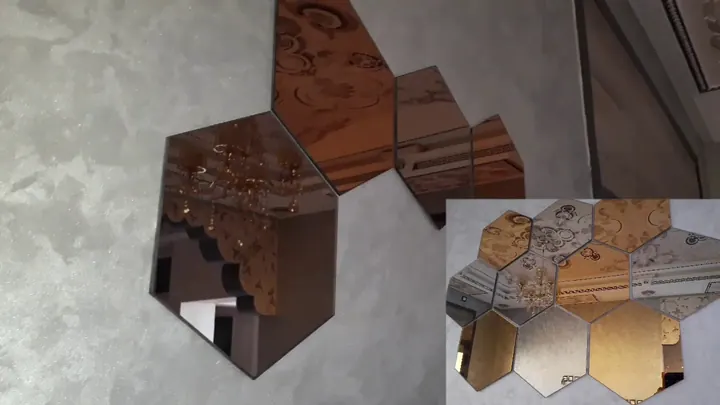
- Custom shapes: round, oval, arches and decorative shapes to your design.
- Decorative glass: frosted, coloured or printed panels as backdrops and wall accents; compare the options in our privacy glass guide.
What's the difference between frameless, framed, bathroom and decorative glass?
| Type | Best for | Key notes |
|---|---|---|
| Frameless mirror | Hallways, bedrooms, lounges | Clean look, but the edge is exposed, so it needs good treatment and protection from water. |
| Framed mirror | Entrances, majlis, bathrooms | The frame partly protects the edge and adds character, but it doesn't replace correct fixing. |
| Bathroom mirror | Vanities and main bathrooms | Humidity is the main enemy; ventilation and edge treatment matter more than the shape. |
| Mirror wall | Dressing rooms, gyms, shops | Needs a flat wall and a carefully planned fixing because weight and area are large. |
| Decorative glass (frosted/coloured/printed) | Backdrops and decorative dividers | Shape and finish are decided before fabrication and can't be changed afterwards. |
Which mirror thickness should I choose?
Common wall mirrors are usually fairly thin (roughly 3 to 6 mm), while very large sizes need a specific study of weight and fixing method. This is guidance only; the final decision comes after measuring and inspecting the wall. If the mirror sits where it may be knocked, such as children's rooms or gyms, ask about safety options like a protective backing, and read our glass thickness guide and children's glass safety guide for the general picture.
How do I choose the edge, frame and shape?
- Bevelled edge: adds a classic touch and catches light at the edges; suits ornate mirrors.
- Smooth (polished) edge: a calm modern look, and the most common choice for wall mirrors.
- Frame: choose the material for the place; aluminium and metal suit wet areas better than untreated wood.
- Shape: round and oval soften the lines of square rooms, and a tall rectangle emphasises height.
- Position: a mirror facing a window multiplies natural light, but avoid placing it where it reflects sun glare into the eyes.
Why do mirror edges turn black in bathrooms, and how do we prevent it?
A mirror is a reflective metal layer protected by a back coating. If moisture or cleaners creep in at the edge, the coating starts to corrode and dark spots spread inwards. Repeated steam in bathrooms and water running onto the bottom edge are among the most common causes. So we treat the edges and choose fixing that doesn't trap water behind the mirror, and we recommend ventilating the bathroom after showers and keeping cleaners away from the edge. It's the same idea as removing limescale from glass: a little regular care saves you a replacement.
How is a mirror fixed safely?
- Mirror-specific adhesive: some adhesives, especially solvent-based ones, can react with the back coating. We use an adhesive suited to mirrors, following the manufacturer's data sheet.
- Adhesive layout: applied in strips or dabs that leave an air path, not a solid layer that traps moisture and fumes.
- Mechanical support: large, heavy mirrors aren't left on adhesive alone; we add fixings or a supporting base according to weight.
- Temporary support: we hold the mirror in place until the adhesive has fully cured, and the support isn't removed early.
- Wall flatness: an uneven wall distorts the reflection and stresses the glass, so we check it before installation and may recommend levelling it.
- Protective safety backing: if present, it may not suit every adhesive, so we test adhesion on a sample first.
What affects the price of mirrors and decorative glass?
- Mirror area, number of pieces and special sizes.
- Thickness and type of glass (clear, tinted, mirror with a protective backing).
- Edge type: smooth or bevelled, and the difficulty of round or custom shapes.
- The frame, its material and finish, if you want one.
- Fixing method: adhesive only, or with fixings or a supporting base.
- Wall condition and whether it needs levelling or removal work before installation.
- Height, access and transport to the site.
- We don't quote a price before measuring because these factors change the quote a lot; for more, see how glass is priced.
How do we work, step by step?
- Site visit and measurement: we measure the wall and check its flatness and surface type.
- Detailed, itemised written quote: sizes, edges, frame and fixing.
- Fabrication to size: we cut the mirror and treat the edges to the agreed specification.
- Installation: clean fixing with suitable adhesive and support where needed, with floors protected.
- Handover: we check the reflection and edges with you and explain care. For the whole sequence, read the stages of a glass project.
What are the most common mistakes when ordering mirrors?
- Relying on an approximate size without actual measuring; see how to measure for glass.
- Installing a mirror in a bathroom without edge treatment or ventilation.
- Relying on adhesive alone for a large mirror instead of mechanical support.
- Fixing onto an uneven wall or freshly painted wall that hasn't dried.
- Using ammonia cleaner or spraying liquid directly onto the edge.
- Changing the shape or edge after fabrication, which is usually not possible.
How do I look after a mirror?
- Wipe with a microfibre cloth lightly dampened with a gentle glass cleaner, then dry.
- Spray the cleaner onto the cloth, not the mirror, so it doesn't run to the edge.
- Ventilate the bathroom after showers and wipe water off the bottom edge.
- Avoid abrasives and harsh cleaners near edges.
- Check edges regularly; a small spot calls for early treatment. For more, read our glass and aluminium maintenance guide.
What do we need from you to quote accurately?
- Photos of the space and the wall the mirror will go on.
- Approximate width and height, which we confirm by measuring.
- The mirror type you want: frameless, framed or a special shape.
- Wall type (paint, tile, marble, gypsum) and any switches or lights nearby.
- Whether it's a bathroom or wet area, and whether there's ventilation.
- Your neighbourhood and preferred installation date.
Questions to ask any mirror supplier before you decide
- Will they measure on my site and give me an itemised written quote?
- How will they treat the edges, and what protects against humidity in a bathroom?
- Which adhesive is used, and is it made for mirrors?
- Will a large mirror be fixed mechanically or by adhesive only?
- What happens if the wall is uneven?
- Who bears breakage during installation? To compare suppliers, read how to choose a glass contractor in Riyadh.
Summary
A good mirror is precise measuring, a treated edge and fixing that suits the weight and the place, not just silvered glass. Think about the whole room: where the light falls, what the mirror will reflect and who will use the space, then choose the size, edge and frame on that basis. The best result comes when these details are settled before fabrication, not after. Send us photos and the wall dimensions, and we'll inspect it and give you a detailed written quote before any fabrication. If your project also includes a bathroom, see our shower enclosures, or doors and partitions in tempered glass.
How we work
Get in touch
Send us a photo and a short description on WhatsApp.
Visit & measure
Our technician visits your site and takes the measurements.
Written quote
Materials, timeline and price in writing before any fabrication.
Fabricate & install
We build, install and leave your site clean.
We don't publish a generic price per metre: every project differs in thickness, hardware and installation, so we give you a written quote after the site visit.
FAQ: Mirrors & Decor
Are bathroom mirrors affected by humidity?
Yes, humidity affects the edge and the back coating if they aren't treated. We treat edges and choose adhesive and fixing suited to bathrooms, and we recommend ventilation.
Why do black spots appear on a mirror's edge?
Usually moisture or cleaners creeping in at the edge and corroding the back coating. Prevention is easier than repair: edge treatment, ventilation and not spraying cleaner onto the edge.
Can a large mirror cover a whole wall?
Yes, after checking the wall is flat, with mechanical fixing suited to large sizes, not adhesive alone.
Do you cut mirrors to order?
Yes, they're cut to your size and shape before fabrication, but the size or shape can't be changed after fabrication.
Do you make round or custom-shaped mirrors?
Yes: round, oval and decorative shapes to your design. Send us the idea or a rough sketch.
Which is better: a framed or a frameless mirror?
It depends on the space and taste; a frame adds character and partly protects the edge, while a frameless mirror looks cleaner but needs good edge treatment.
Can a mirror be installed without drilling the wall?
Sometimes, with a suitable adhesive, but large or heavy mirrors usually need mechanical support, which we decide after inspecting the wall.
How do I find out the price of a mirror?
We don't set a price before measuring because it changes with size, edge, frame and fixing. Send photos and dimensions and we'll send a detailed written quote.