Tempered glass can break without any visible impact because of a microscopic nickel sulfide inclusion inside the pane that slowly expands over time, but this is rare and is not the most common cause of breakage. The risk can be reduced with the heat soak test or by using heat-strengthened or laminated glass, and no measure can guarantee an absolute zero.
Does tempered glass really break on its own?
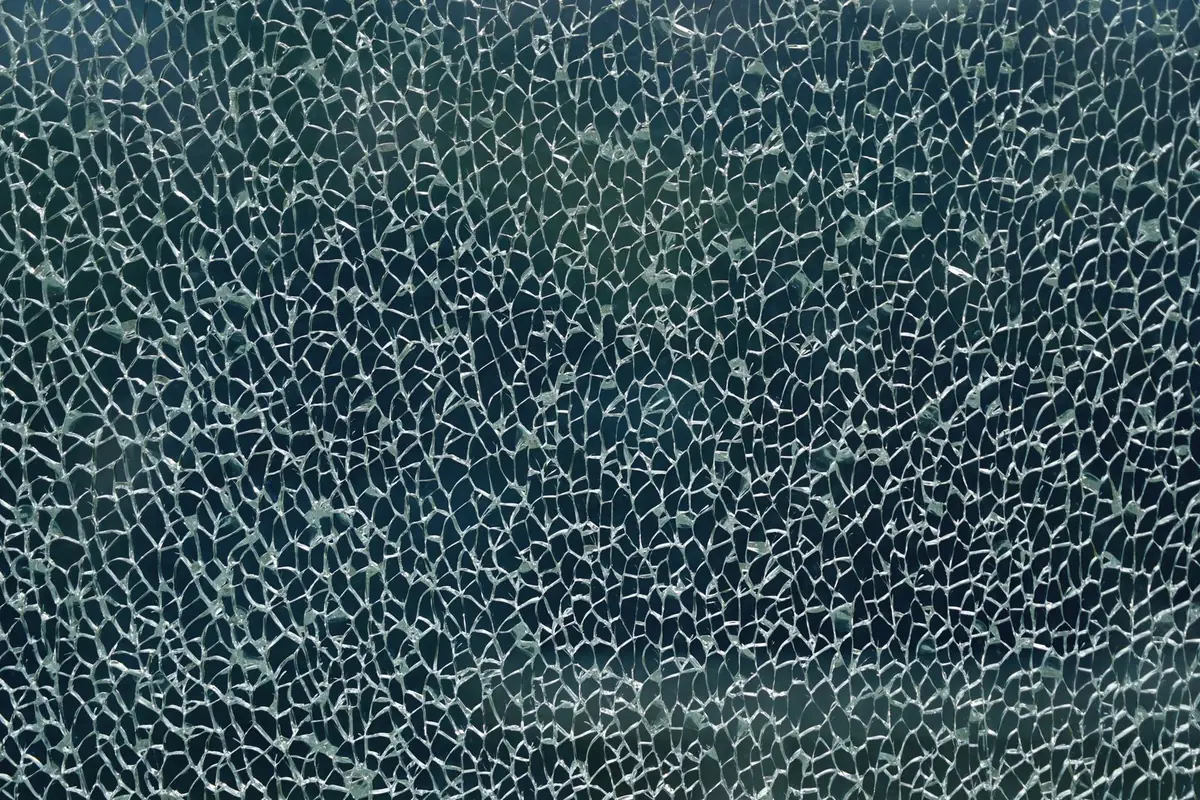
Yes, it happens, but it is rare, and the technical literature calls it “spontaneous breakage.” Exaggerating it makes some people fear tempered glass altogether, while denying it completely makes others ignore simple precautions. The truth lies in the middle: tempered glass is a safe material, widely used in doors, partitions and showers, but in some critical locations such as high facades this risk is taken more seriously. Before attributing any breakage to a “hidden defect,” you must rule out the far more common causes, which we cover below. No measure guarantees an absolute zero risk, so the decision remains a practical one: assess the effect of breakage on people and cost in your location, then choose the appropriate build-up and testing. What is nickel sulfide (NiS)? Nickel sulfide consists of very fine impurities that can enter float glass during manufacturing from raw material sources or production equipment, and their size is usually very small and not visible to the naked eye in most cases. Their presence in float glass causes no notable problem because float glass carries little internal stress. The problem appears when the glass is tempered, because the core of the pane comes under internal tensile stress, and if an inclusion lies in this zone it becomes a potential starting point for breakage. How does this inclusion cause breakage? Research indicates that nickel sulfide exists in tempered glass in a phase that is stable at high temperature and tends over time to convert to another phase that is more stable at room temperature. This transformation is accompanied by a slight increase in volume, so the inclusion presses on the surrounding glass, which is already under tension, and a crack may start and spread rapidly, shattering the pane. Timings vary entirely: breakage may occur after months or years, or never. The technical literature indicates that larger inclusions located in the tension zone at mid-thickness are the most dangerous.
What does a nickel sulfide breakage look like?
- The pane breaks with no visible impact, scratch or heat beforehand.
- Examining the break usually shows a single origin point roughly in the middle, shaped like “butterfly wings” or two opposing points.
- A small white or gray inclusion may be present at the center of this pattern.
- This pattern does not prove the cause on its own; confirmation requires specialized laboratory examination.
Is tempering the cause?
Tempering is not the cause in itself, but it creates the conditions that can make an inclusion act as a weak point. That is why the likelihood is lower in heat-strengthened glass, which is cooled more slowly so the tensile stress in its core is lower, an advantage used in facades. In laminated glass, the breakage of one ply does not mean the pane falls, because the interlayer holds the fragments. To compare the types, see types of glass: a complete guide and the laminated glass guide. What is the Heat Soak test? It is a prolonged heating test carried out on tempered glass panes in a special oven before delivery. The idea is to accelerate the transformation in any existing inclusions so that a defective pane breaks inside the factory instead of at your site. The European standard EN 14179 covers this test for heat-soaked tempered glass. The details of the test conditions (temperature and hold time) are in the text of the standard and vary between editions, so we give no figures here and refer you to the supplier to state them explicitly in its documents. Research indicates that the test reduces the risk but does not eliminate it, and that it adds cost and time because it is a batch process.
Options for reducing the risk and when they suit
| Option | How it helps | Limits | When to consider it |
|---|---|---|---|
| Standard tempered | The most widespread and least costly solution | The rare risk remains | Interior doors, partitions and showers |
| Tempered + Heat Soak | Reduces the chance of breakage on site | Does not guarantee zero; adds cost and time | High facades, locations hard to replace or above passersby |
| Heat-strengthened | Lower chance of spontaneous breakage | Not safety glass on its own | Facades, and as plies inside laminated glass |
| Laminated | The pane stays in one piece if it breaks | Heavier and costlier | Roofs, balustrades, canopies, anything overhead |
The most common causes of tempered glass breakage
Before blaming nickel sulfide, review the more frequent practical causes. Edge defects: an edge that was scratched or slightly chipped during transport or installation becomes the start of a crack after days or weeks. Glass-to-metal contact: glass pressed against a frame, screw or hinge without a rubber spacer. Installation stress: a pane installed in an uneven opening and forced to bend. Localized impacts on the edge or corner. Thermal expansion when the gaps around the pane are completely closed so it has no room to expand with the sun's heat. In all these cases the pattern is different: the starting point is at the edge or at the point of pressure, not in the middle of the pane.
What should you do if a pane breaks for no obvious reason?
- Secure the area and keep children and pets away, and wear gloves and closed shoes when collecting pieces.
- Photograph the breakage as it is before cleaning, then keep the pieces near the origin point if possible and as the supplier directs.
- Note the details: when it happened, whether there was an impact or heat, the installation date and the location.
- Notify the supplier and send the photos; they are responsible for determining the cause and acting according to the documents.
- If it is significant (a facade, or several panes), request an examination by an independent laboratory.
What should you expect from the warranty?
We do not promise warranty terms here because they are set in written documents. What we advise is to ask before ordering for an explicit clause in the quotation: does it cover breakage not caused by impact or poor installation? What proof is required? Does it include removal and installation labor? And in a facade or glass roof project, ask for the specification to state whether standard tempered, heat-strengthened, Heat Soak or laminated glass is required.
Practical tips to reduce the risks
- For overhead locations (such as canopies and roofs, see glass canopies and roofs) or high facades, use laminated or heat-strengthened glass as designed by the engineer.
- Request Heat Soak for critical locations and state in the quotation that it is required; do not assume it is implied.
- Make sure the edges are polished and protected during transport and installation.
- Use rubber or nylon spacers between glass and metal, and do not overtighten screws.
- Leave suitable expansion gaps, especially outdoors in Riyadh's intense sun.
- For more on general steps after breakage, read glass broke: what to do?.
Myths and facts
- Myth: tempered glass often breaks on its own. Fact: spontaneous breakage is rare, and most breakages are caused by edges, installation and impacts.
- Myth: Heat Soak guarantees no breakage ever. Fact: it reduces the chance but does not eliminate it.
- Myth: every breakage from the middle is nickel sulfide. Fact: laboratory examination is needed to confirm it.
- Myth: laminated glass never breaks. Fact: it breaks but stays in one piece.
Why does tempered glass need more attention than float glass?
Because tempering stores energy in the pane: a compressed surface and a tensioned core. This is what gives it strength, and it is also what makes breakage, if it starts, spread through the whole pane so it shatters instead of cracking in a single line. Shattering is therefore not evidence of a defect; it is the intended way tempered glass behaves. This explains why roofs and facades are planned so that the shattering of a single pane does not drop fragments on people, by adding laminated glass or designing protection below. For more on the principle of tempering, see what is tempered glass. Is what happens in Riyadh different? There is nothing to indicate that the risk associated with nickel sulfide differs by city; it relates to the quality of the raw glass and the tempering process. But the hot climate raises the thermal stress on panes exposed to the sun, which makes edge- and expansion-related breakage more likely in large facades. So do not attribute every summer breakage to an inclusion, and examine the origin point. In large exterior work, it is recommended that the engineer set an explicit specification for the glass type and its treatment.
Questions to ask the supplier about this risk
- Are the panes supplied standard tempered or heat-strengthened?
- Is a Heat Soak test recommended for this location, and to which standard is it performed? (Ask for this to be stated in the quotation.)
- Does the supplier have documents proving the test was performed and its batches, if requested?
- What is the replacement procedure if a pane breaks for a reason other than impact, and who bears the cost?
- Is the location above walkways so that laminated glass is required instead of single tempered?
- Are the edges polished and inspected before delivery?
How do you deal with fear of this problem?
In most small projects the risk can be managed through design before testing: use single tempered glass where its breakage endangers no one (room doors, shower screens), use laminated glass or protective design where the risk is greater, and request Heat Soak when needed. Do not pay for a test in a location that does not call for it, and do not drop the test where it is called for because the price is lower. Most importantly, the specification must be written in the quotation: what is required and what is excluded. How do you read the shape of the breakage? A simple guide. The shape of the break gives the first clue to the cause. If the cracks start at the edge or corner and spread inward, the cause is usually an impact or an edge defect. If they start at a pressure point (a screw, hinge or metal contact), the cause is localized stress. If they start at the middle of the pane with no external trace, an internal inclusion is considered as a possibility. Two adjacent pieces shaped like wings may appear at the origin. These are indicative signs, and a final judgment requires laboratory examination, so do not rely on them alone in a dispute with the supplier. What is the difference between spontaneous breakage and thermal stress? Thermal stress occurs when one area of the pane heats more than another (sun on one part and shade on another), generating stresses that break a float pane, and it is usually seen as a crack starting at the edge. Nickel sulfide, by contrast, is an internal cause. In large exterior facades, the design must account for this difference, through glass type, polished edges and expansion gaps. This explains the differences we see in specifications between interior door glass and building facades.
What can you do after installation?
- Visually inspect large panes for edge cracks or any change in their appearance.
- Make sure the rubber and spacers are intact and that glass does not touch metal directly.
- Do not attach items that press on the pane (shelves, hangers) without consulting the supplier.
- Keep the purchase documents, the installation date and site photos.
- At any unexplained breakage, photograph before cleaning and notify the supplier in writing.
Summary
Nickel sulfide is a real but rare risk, and it should not stop you from using tempered glass in your doors and partitions. Know the probability and apply it to the location: a low-risk interior location is fine with standard tempered glass, while a high facade or a roof deserves Heat Soak or laminated glass. If breakage happens, photograph it before cleaning and notify the supplier, and see the tempered glass service to request a measurement and a written quotation.
FAQ
Why does tempered glass suddenly break?
Most causes are practical ones such as edge defects, localized pressure and thermal expansion. In rare cases, microscopic nickel sulfide inclusions inside the pane may be the cause. Telling them apart requires examining the origin point of the break.
What is nickel sulfide in glass?
It is a microscopic inclusion that may form inside the pane during manufacturing. In tempered glass it can expand slowly over time and start a crack in the tension zone. It is very rare and usually not visible to the naked eye.
Does the Heat Soak test prevent spontaneous breakage?
It reduces the likelihood by breaking defective panes inside the factory before they are installed, but it does not eliminate the risk entirely and adds cost and time. It is usually requested for facades and critical locations, not for every small project.
Is laminated glass safer in spontaneous breakage?
Yes, because the interlayer keeps the fragments bonded so the pane does not fall. That is why it is preferred in roofs, facades and balustrades, where falling glass is a danger.
Does the warranty cover spontaneous breakage?
That depends on the written warranty text from the supplier. Before contracting, ask for an explicit clause on breakage not caused by impact or installation, and on whether it includes removal and installation.
How do I distinguish nickel sulfide breakage from ordinary breakage?
A breakage caused by an inclusion usually starts from a point at mid-thickness away from the edge, whereas edge or pressure breakage starts at the edge or at the fixing point. Confirmation requires laboratory examination.